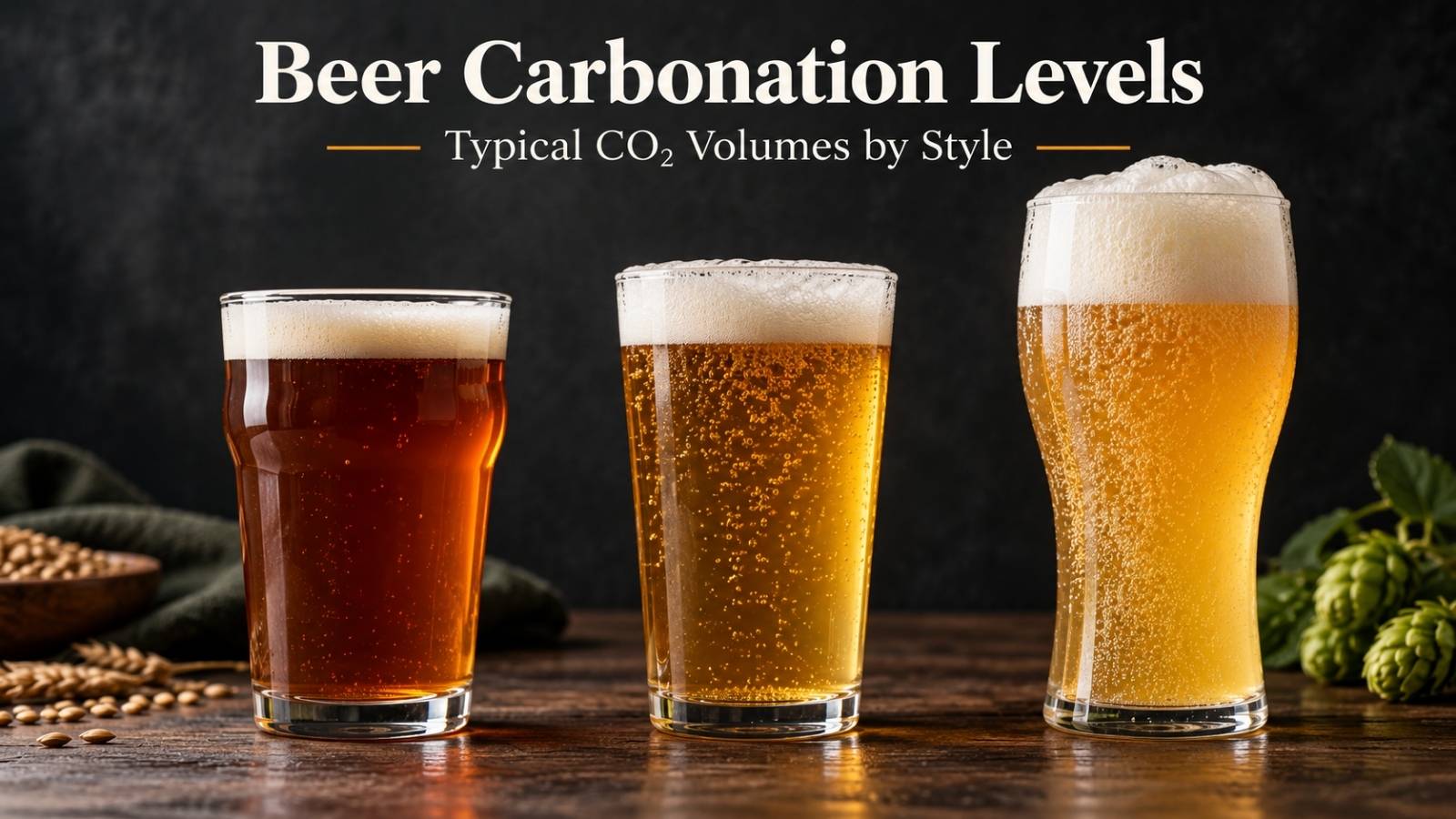
Beer Carbonation Levels: Typical CO₂ Volumes by Style
Typical CO₂ volumes for common beer styles, with practical ranges to help you choose a carbonation target.
Beer carbonation levels vary more by style than a single target number suggests. How much carbonation should you actually put in your beer?
That sounds like a question that ought to have one neat answer per beer style.
It doesn’t.
Carbonation is part of the way a beer tastes and feels, not just another number to hit. The style gives you a useful place to start, but the beer itself, the way you serve it, your equipment and your own preference all matter.
So I use carbonation ranges as reference points, not rules.
If I am deciding what to do with a new keg, this is the kind of table I want in front of me.
Beer Carbonation Levels by Style
The table below shows typical beer carbonation levels for common styles, along with practical starting ranges.
| Beer style / group | Typical CO₂ volumes | Practical note |
|---|---|---|
| British bitter / cask-like ale | about 1.0–1.5 | Soft and restrained. Traditional cask presentation sits particularly low. |
| Mild / English brown ale | about 1.5–2.1 | A softer level works well with malt and body. |
| British-style porter / stout | about 1.5–2.2 | Usually restrained compared with modern American ales. Nitro stout is a different serving setup. |
| American porter / stout | about 1.7–2.3 | More carbonation is common than in cask-like British versions, but sources vary. |
| American amber / pale ale | about 2.2–2.7 | A useful middle ground for many modern American ales. |
| American IPA | about 2.2–2.6 | Enough lift for the hops without carbonation having to dominate the beer. |
| Kölsch | about 2.4–2.7 | Lively rather than aggressive works well with the light, crisp character. |
| Pilsner / European pale lager | 2.4–2.6 | A fairly narrow, well-established lager range. |
| American lager | 2.5–2.8 | Generally a little more highly carbonated than many European lagers. |
| Witbier | about 2.7–3.3 | High carbonation suits the light, refreshing character. |
| Saison | about 2.8–3.5 | Intentionally lively and effervescent. |
| Hefeweizen / German wheat beer | about 3.0–4.0 | Traditionally very lively; some examples go considerably higher. |
| Belgian Tripel | about 3.0–3.5 | High carbonation is part of the dry, effervescent presentation. |
| Gueuze | about 3.0–4.0 | Sparkling blended lambic; some examples go higher. |
A couple of important caveats before you start dialing regulators: these are practical reference ranges, not official specifications.
The strongest numerical references tend to group beers into broad families. Brew Your Own, for example, gives American ales as 2.2–3.0 volumes, British ales as 1.5–2.2, Belgian ales as 2.0–4.5 and German Weizens as 2.8–5.1.
Several of the narrower ranges in my table are therefore practical sub-ranges, cross-checked against style descriptions and more specific secondary brewing references. BJCP is useful here for descriptions such as low, high, effervescent or highly carbonated, but BJCP generally does not give numerical CO₂-volume targets.
That distinction matters. I don’t want a number in a table to look more official than it really is.
Belgian ales deserve their own warning label
“Belgian ale” is far too broad to have one useful carbonation number.
Published family references span roughly 2.0–4.5 volumes of CO₂, which is a clue that you should look at the particular beer rather than the word Belgian.
A Witbier, Saison and Tripel can all be highly carbonated, but they are not interchangeable beers. Use the specific rows above as starting points and then look at the beer you are actually making.
What does “volumes of CO₂” mean?
A volume of CO₂ is simply a way of expressing how much carbon dioxide is dissolved in the beer.
One volume means that the dissolved CO₂ would occupy the same volume as the beer when measured as gas under standard reference conditions.
You do not really need that definition every time you carbonate a keg.
What matters at the brew bench is that the number gives us a common scale.
A beer at 1.5 volumes feels very different from one at 3.5.
Once you decide where you want to be on that scale, you can work out the pressure needed to get there at the actual temperature of your beer.
How I would use this table
I treat these beer carbonation levels as starting points, not fixed targets. I would not find “American IPA”, see 2.2–2.6 volumes and decide that 2.4 must therefore be correct.
It might be.
But that is not what the table is telling us.
If the beer is full-bodied and soft, I might start toward the lower part of the range. If it is lean, dry and hop-forward, I might prefer a little more lift.
The same idea works in the other direction with maltier beers. Lower carbonation can let body and malt sit more comfortably in the foreground. Push the carbonation higher and the beer becomes livelier, with more carbonic bite.
BYO also notes that higher carbonation can accentuate hop character, while too much carbonation can mask malt character in beers where malt is meant to lead.
So the style gives me a neighborhood.
The beer in the keg decides where I actually want to live.
What carbonation changes in the glass
Different beer carbonation levels change how body, malt, hops and carbonic bite are perceived. There are no hard borders between “low”, “medium” and “high”, but thinking in those terms is still useful.
Lower carbonation
Lower carbonation tends to feel softer and less prickly.
That can suit bitters, milds, porters and other beers where you want malt, body or easy drinkability to do most of the talking.
Take it too far, though, and a beer that was meant to be lively can simply feel flat.
Medium carbonation
This is where a lot of the beer I brew naturally ends up.
Pale ales, amber ales and IPAs can have enough carbonation to lift the beer and support the hops without the carbonation becoming an attraction of its own.
There is a reason the middle of these ranges is such a comfortable place to start.
It just should not become a reflex.
Higher carbonation
Higher carbonation gives you more effervescence and more of that carbonic prickle.
In Saison, Witbier and Hefeweizen, that liveliness is part of the character rather than an accidental side effect.
It can also change how flavor presents itself. Higher carbonation can bring more life to hop-forward beer, while excessive carbonation can get in the way of a malt-focused beer.
And carbonation does not simply make every beer “lighter”. In some thin beers, dissolved CO₂ can actually add to the perception of fullness.
That is why I would rather describe the effect than reduce it to “more CO₂ = more refreshing”.
Beer is annoyingly uncooperative when we try to make the rules too simple.
When one regulator has to serve several kegs
There is another part of this that style tables tend to ignore:
Your brewery gets a vote.
I have three kegs but only one CO₂ regulator feeding all three through a simple manifold. One connection comes from the regulator, and the three outlets feed the three kegs.
So all three get the same applied CO₂ pressure.
That means I sometimes deliberately choose a carbonation level that works reasonably well across more than one beer.
If the kegs are held at the same temperature and stay connected to the same applied CO₂ pressure, they will tend toward essentially the same equilibrium carbonation level.
A beer below that equilibrium will absorb CO₂.
A beer that starts above it will tend to move downward as beer is poured or the keg is vented. In a closed keg, it does not simply dump the excess CO₂ back through a normal regulator.
And none of this happens the moment I connect the gas.
With normal set-and-forget carbonation, changes are gradual — often on the scale of one to a few weeks rather than minutes.
So if I have one keg that I would ideally like at 2.1 volumes, another at 2.4 and another at 2.7, I have a choice.
I can build a system that lets me regulate them separately.
Or I can find a pressure that gives me a sensible middle ground.
Quite often, I choose the middle ground.
If I have an amber ale, pale ale and IPA on tap, I would rather have three good beers at one practical setting than convince myself I need another equipment project before I can pour a pint.
The goal is good beer, not maximum regulator count.
Secondary regulators are absolutely useful if you regularly want beers at very different carbonation levels. A Hefeweizen and a low-carbonation bitter are an obvious example.
But one regulator and a manifold is not a broken system. It simply means you understand the compromise you are making.
This assumes you are using 100% CO₂. If you use a CO₂/N₂ blend, carbonation is governed by the CO₂ partial pressure rather than the total gas pressure, so the calculation changes.
Your preference still wins
A style reference gets you into sensible territory.
After that, your own palate is allowed to interfere.
If you consistently prefer your IPA slightly softer than the reference range suggests, there is no carbonation police waiting outside the garage.
Set it lower.
If you like your wheat beer particularly lively, and your kegging or bottling equipment is rated for the pressure involved, move upward.
More importantly, write down what you did.
It is surprisingly easy to remember that one keg was “really good” and completely forget whether it was sitting at 0.8 bar or 1.1.
I have been brewing since 2015, and notes still beat memory.
From CO₂ target to regulator pressure
Once you have chosen a target, the next question is much easier:
What regulator pressure gives me that carbonation level at the temperature of my beer?
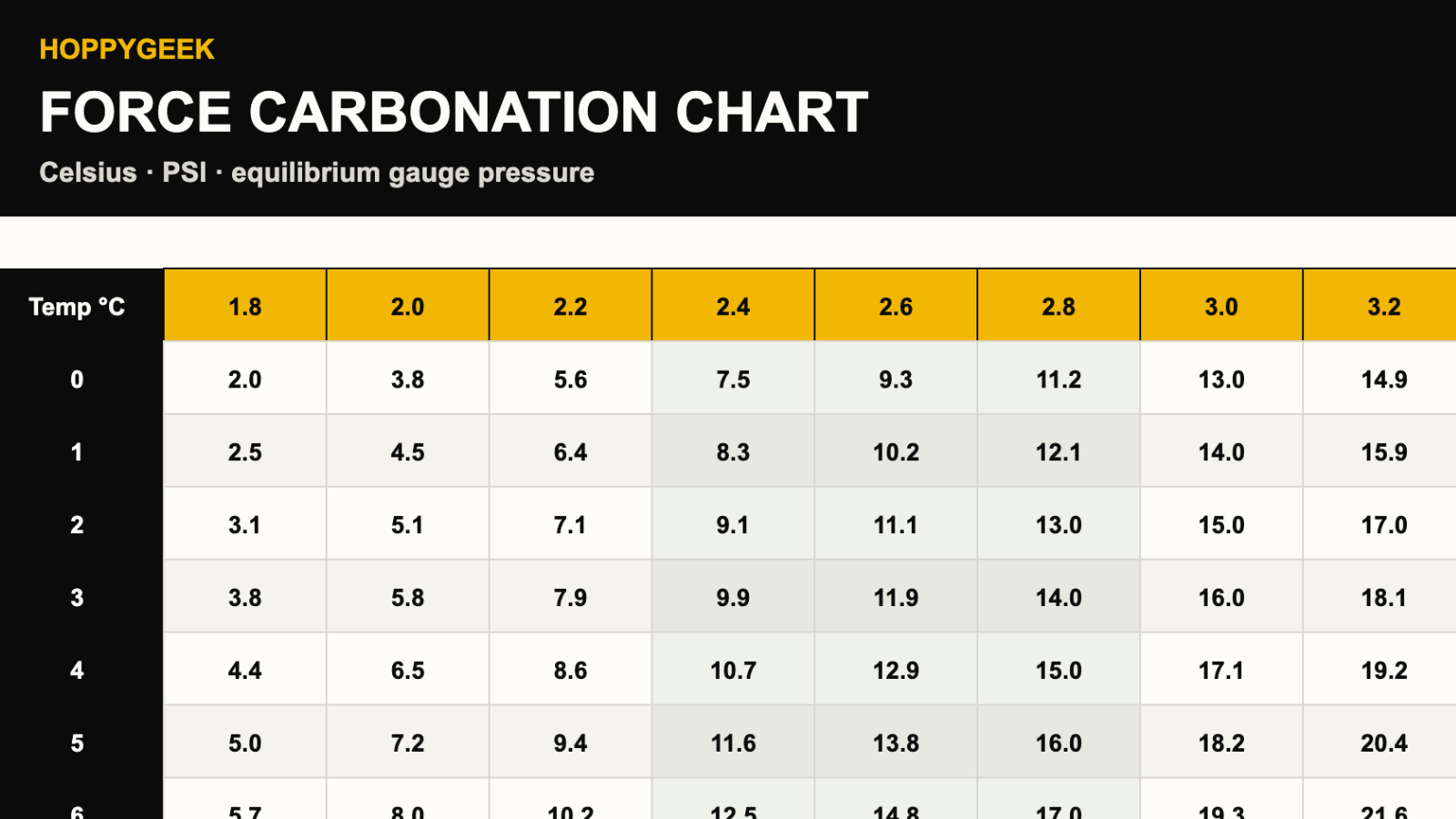
That is exactly what my Force Carbonation Calculator is for.
Enter your beer temperature and chosen CO₂ target, then use whichever pressure and temperature units make sense for your setup.
I use °C and PSI myself, which is why the calculator does not force you into either an all-metric or all-imperial combination.
Choose the carbonation level here.
Then let the calculator deal with the pressure.
A quick safety note
Higher carbonation requires higher equilibrium pressure at the same beer temperature.
Make sure the keg, regulator, fittings, tubing and pressure-relief hardware you use are rated for the pressure involved.
If you bottle-condition highly carbonated beer, make sure the bottles and closures are suitable for that carbonation level too. Do not assume an ordinary beer bottle is appropriate just because the beer fits inside it.
The short version
Use these beer carbonation levels to choose a sensible target, then adjust for the beer and your own setup.
Start somewhere that suits the beer rather than automatically choosing the exact midpoint.
Taste it.
Adjust the next keg if you want to.
And if several kegs have to share one regulator pressure, a practical compromise is a perfectly reasonable way to run a home brewery.
Once you have your target, use the Force Carbonation Calculator to turn that CO₂ level into the PSI or bar your beer actually needs.
References
- BJCP — “2021 Beer Style Guidelines”
Used as a qualitative cross-check for carbonation character, including restrained British styles and highly carbonated or effervescent Belgian and wheat styles. BJCP is not treated here as the source of numerical CO₂-volume ranges.
Accessed October 1, 2026. - Brew Your Own — “Carbonation Priming Chart”
Numerical family ranges for American ales, British ales, German Weizens, Belgian ales, European lagers and American lagers.
Accessed October 1, 2026. - Brew Your Own — “Properly Priming Your Homebrew”
Numerical family ranges plus discussion of carbonation, carbonic prickle, malt character, hop character and cask-conditioned ale.
Accessed October 1, 2026. - Brewfather — “Packaging, Carbonation & Oxygen Control”
Secondary reference for more specific practical style ranges, including American porter/stout, American amber/pale ale, American IPA, Witbier, Saison, Hefeweizen and Lambic/Gueuze. Brewfather states that its table is adapted from BJCP 2021 and Noonan 1996; BJCP itself should not be read as the numerical source.
Accessed October 1, 2026. - Brewers Association — “Draught Beer Quality Manual”
Reference for the relationship between beer temperature, applied pure-CO₂ pressure and equilibrium carbonation, including equilibrium pressure tables.
Accessed October 1, 2026.