Dry Hopping: What Actually Matters?
What actually matters when dry hopping homebrew: timing, oxygen, contact time, hop creep and keeping the process simpler.
Dry hopping sounds simple enough. Fermentation is underway or finished, you add hops to the fermenter, give them some time, and hopefully get more of that fresh hop aroma into the beer.
Then you start reading about it.
Should the hops go in during active fermentation? After final gravity? At 20°C or 12°C? Should they stay in for two days or seven? Do you need a hop bag, magnets, a hop dropper, CO₂ purging, or some elaborate closed system? And somewhere in the middle of all that, somebody will probably warn you about hop creep, grassy flavours, oxidation, or all three.
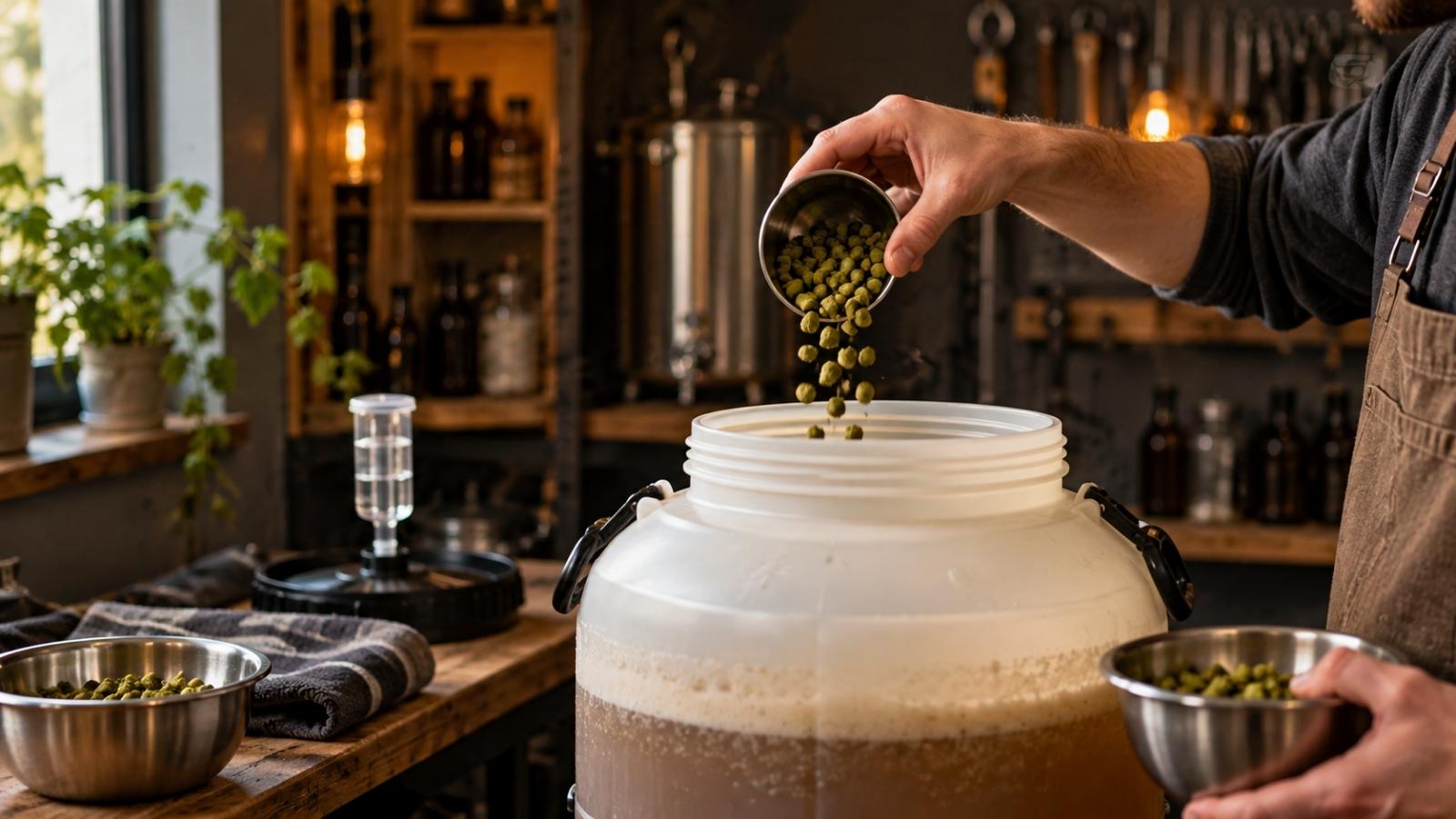
I’ve dry hopped quite a few beers over the years, and most of the time I’ve done it in the least glamorous way possible: open the fermenter, pour the pellets in, close it again. That method still works.
The useful question isn’t how complicated you can make dry hopping. It’s which parts actually make a difference in the glass.
What Dry Hopping Actually Does
Dry hopping means adding hops on the cold side, after the boil. The main reason is to get more hop aroma and flavour into the finished beer without boiling those hops first.
That makes it especially useful in beers where fresh hop character is a big part of the experience. Citrus, tropical fruit, floral notes, resin and other hop aromas can become much more obvious.
More hops don’t automatically mean proportionally more aroma, though. Research into dry-hop rates has found diminishing returns at high rates. At some point you’re adding a lot more hop material without getting the same increase in aroma back.
I think that’s more useful as a principle than as a magic number. How much I want to use still depends on the beer I’m trying to make.
Do You Need to Sanitize the Hops?
I don’t sanitize hop pellets before dry hopping.
I wouldn’t soak them in Star San, boil them, spray them with sanitizer or invent some homemade treatment. I take fresh hops that have been stored properly, open the package and put them into the beer.
That doesn’t mean hops are sterile, or even sanitized. They aren’t.
What helps is the environment they’re going into. Finished beer is a difficult place for many unwanted microorganisms. It has alcohol, a low pH, little easily available sugar and bitter hop compounds left over from the boil. Some beer-spoilage bacteria are adapted to survive those conditions, so none of this is a magic shield against contamination.
For me, the practical distinction is simple: I leave the hops alone, but anything else that touches the beer gets the usual cold-side treatment. A hop bag should be sanitized. A magnet inside the fermenter should be suitable for food contact and sanitized. The same goes for fittings, spoons, hoses or anything else that actually meets the beer.
The hops themselves are not where I spend most of my worry.
Prefer to watch a video about this subject, rather than read about it? The video is in Norwegian, with subtitles in English available.
Timing: There Is No Single Right Moment
My usual approach is to dry hop fairly late.
For many of my beers, I add the hops for roughly the final three days before transferring to a keg. I might give them around two days at fermentation temperature and let the final day overlap with the cold crash. By then, fermentation has normally been finished for a while.
That’s not the only sensible way to do it.
Adding hops while fermentation is still active can have some advantages. The yeast is still working and CO₂ is still being produced, so a small amount of oxygen introduced with the hops may be less worrying than it would be in a beer that has been sitting completely finished for several days.
I deliberately say “less worrying,” not “protected by a CO₂ blanket.” Gases mix. CO₂ in the fermenter doesn’t create an invisible force field over the beer.
Active yeast can also change some hop-derived compounds into others. That’s what people usually mean when they talk about biotransformation. It can shift the hop aroma rather than simply making the same aroma stronger, and the result depends on both the yeast and the hops.
So I wouldn’t treat active fermentation as a button you press for better hop aroma, because there’s a trade-off too.
During active fermentation, some volatile hop compounds can leave the beer with the CO₂, while others are affected much less. Earlier and later dry hopping can therefore give different results rather than one of them simply being the correct method.
I’d look at the recipe, the yeast, how quickly the fermentation is actually moving and the hop character I want.
Sometimes the beer makes part of that decision for you. I’ve brewed beers where fermentation moved so quickly that the beer was practically finished long before the recipe called for the dry-hop addition. Moving the hops forward just to catch active fermentation wouldn’t be a small process tweak anymore. I’d be changing the recipe.
Temperature and Contact Time Belong Together
Dry-hop temperature sometimes gets discussed as though there should be one correct number, but temperature is tied to everything else you’re doing.
Warmer dry hopping generally speeds extraction and gives hop enzymes and yeast more opportunity to get fermentation moving again. Cooler dry hopping slows some of those processes, but that doesn’t mean hop aroma suddenly stops extracting because the beer is cool.
Contact time matters too, and this is one area where old rules can make dry hopping sound more rigid than it needs to be.
One study in alcohol-free beer found that most of the transfer of the measured hop aroma compounds happened during the first two to three days. That doesn’t give us a universal three-day rule for homebrewed IPA, but it does fit the broader picture that dry-hop extraction can happen fairly quickly.
The exact timing will depend on the hops, temperature, hop form, movement in the beer and the system you’re using.
That makes me comfortable with my own fairly short dry-hop schedule. I don’t automatically leave pellets in every beer for a week just because seven days used to be a common recommendation.
The same caution applies to warnings about “grassy” beer. Long contact time often gets the blame for vegetal or grassy flavours, but the evidence isn’t strong enough to make time alone the villain. Hop condition, compounds already present in the hops and oxidation products can all play a part.
So I wouldn’t use “three days good, seven days grassy” as a rule.
Brewing rarely gives us rules that convenient.
Oxygen Matters — But Look at the Whole Cold Side
When you open a fermenter, air gets in, and air contains oxygen. What’s easier to overstate is what happens next.
Opening the lid doesn’t mean your IPA instantly becomes oxidized. I’ve opened fermenters and dumped pellets straight into them for years, and I can’t point to a beer I knew was oxidized because of that hop addition. Plenty of other homebrewers have had the same experience.
How much oxygen actually becomes a problem depends on more than that one moment. How much air gets in, how long the beer is stored, its temperature, what happens during the cold crash, how you transfer it and how you package it all matter.
I do pay more attention to oxygen in hop-forward beers because fresh hop character is such a big part of what I want from them. As those beers age or oxidize, the bright hop character can fade and duller malt, honey-like or eventually papery notes can become more obvious. The beer can lose what made it exciting before it ever tastes dramatically oxidized.
In practice, I try to avoid exposure that doesn’t need to happen.
If I’m adding pellets through the top of a simple fermenter, I get everything ready first. Lid open, hops in, lid closed. I don’t stir the beer, and I don’t leave the fermenter sitting open while I start looking for the hop packet I should have opened beforehand.
A sanitized hop bag held inside the fermenter with magnets is a clever next step. Move the outside magnet and the bag drops into the beer without opening the vessel.
A purpose-built hop dropper that can be purged with CO₂ takes it further again. Nice to have, certainly. Necessary? No.
I also wouldn’t obsess over the hop addition and then ignore everything that comes afterwards.
During a cold crash, the gas in the headspace contracts as it cools. Depending on the fermenter and airlock arrangement, that can pull some room air into the vessel. How much that matters depends on the setup, the amount of headspace and what’s still happening in the beer, so I don’t think it needs to become another reason to panic.
And after that, you still have to move the beer and package it.
That’s why I think about oxygen across the whole cold side: dry hopping, cold crashing, transferring and packaging. Avoid unnecessary splashing and unnecessary exposure. Use closed or CO₂-assisted transfers if your equipment supports them safely, but don’t put pressure on a plastic fermenter that wasn’t designed and approved for it.
A basic plastic fermenter can still make excellent hop-forward beer.
Hop Creep Is Worth Understanding
Hop creep sounds like one of those brewing terms invented to make a simple hobby more complicated, but this one is real.
Hops can bring enzymes into the beer that break some longer, normally unfermentable carbohydrates into smaller sugars. If there’s enough live yeast around, fermentation can start moving again after the dry hops go in.
That can lower the final gravity, make the beer drier, raise the alcohol slightly and produce more CO₂. Dry hopping can also lead to another increase in diacetyl, the compound associated with buttery or butterscotch-like flavours.
This is why a stable gravity before dry hopping doesn’t guarantee that the gravity will still be the same afterwards.
If you bottle condition, that matters for safety as well as flavour. Fermentation continuing inside a sealed bottle means more CO₂ and more pressure on top of the carbonation you deliberately create with priming sugar.
So if I were bottling a dry-hopped beer, I’d want to know that the gravity had stopped moving after the dry hop — before adding priming sugar and packaging it.
Glass bottles and unexpectedly high pressure aren’t a combination I need to experiment with.
What I Actually Focus On
Most of the time, my own method remains fairly boring. I use pellets, prepare everything before opening the fermenter, pour the hops straight in, close it again and keep the contact time fairly short.
For a heavily hop-driven beer, I might have a reason to change that. Maybe I want some hops in while fermentation is still active. Maybe I want a more closed way to add a large charge. Maybe that particular recipe gives me a reason to dry hop cooler or split the additions.
But I want the reason to come from the beer, not from the idea that dry hopping has to be complicated.
If you add the hops loose, you’ll probably have more hop material to deal with during cold crashing and transfer. Put them in a bag or basket and containment gets easier, but the hops still need enough room to get good contact with the beer.
Every method moves the inconvenience somewhere.
If I had to cut the whole subject down to the things I actually care about, I’d use good hops, choose the timing for the beer I’m making, avoid oxygen exposure that serves no purpose, and remember that dry hopping can get fermentation moving again.
You probably don’t need a week of contact time just because somebody once told you dry hopping takes seven days.
And you don’t need to panic because the fermenter was open for ten seconds.
References
- Brewers Association — “Hop Creep – Technical Brief” — Arnbjørn Stokholm & Thomas H. Shellhammer — Accessed October 7, 2026.
- Lafontaine, Scott R. & Thomas H. Shellhammer — “Impact of Static Dry-Hopping Rate on the Sensory and Analytical Profiles of Beer” — Journal of the Institute of Brewing 124 (2018), 434–442 — Accessed October 7, 2026.
- Brendel, Sebastian, Thomas Hofmann & Martin Granvogl — “Studies on the Odorant Concentrations and Their Time Dependencies During Dry-Hopping of Alcohol-Free Beer” — Flavour and Fragrance Journal 35 (2020), 703–712 — Accessed October 7, 2026.
- King, Andrew J. & J. Richard Dickinson — “Biotransformation of Hop Aroma Terpenoids by Ale and Lager Yeasts” — FEMS Yeast Research 3 (2003), 53–62 — Accessed October 7, 2026.
- Sakamoto, Kanta & Wil N. Konings — “Beer Spoilage Bacteria and Hop Resistance” — International Journal of Food Microbiology 89 (2003), 105–124 — Accessed October 7, 2026.
- Klimczak, Krystian, Monika Cioch-Skoneczny & Aleksandra Duda-Chodak — “Effects of Dry-Hopping on Beer Chemistry and Sensory Properties—A Review” — Molecules 28 (2023), 6648 — Accessed October 7, 2026.